
Content Review and Correction
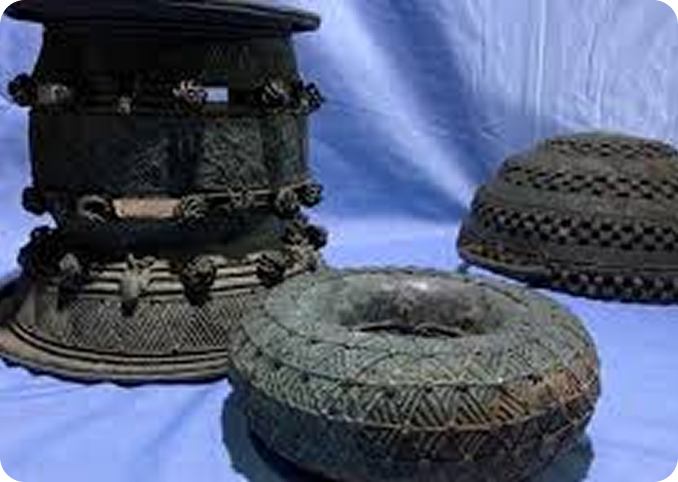
Five or more persons, most likely sacrificial slaves, were placed above the roof of the chamber before the pit was sealed in. Studies by Shaw and most experts agree that what he had discovered in Igbo-Ukwu was the grave of an ancient Eze Nri of Ora-eri. Critical analysis of the archeological findings in terms of Nri/Eri culture and oral history has helped to remove the centuries-old tendency of the Western World to regard the rainforest of Africa as devoid of human settlement and hence irrelevant to world history. It invigorated the research that dramatically reshaped the flawed colonial narratives on cultural, sociopolitical, and prehistory of the Igbo people. According to folklore, the founding father of Nri people was Eri — a divine being supposedly sent by Chukwu (God) to make peace, cleanse abominations, and provide foods for Igbo people. Philologically, Ora-eri means people/community/crowd of Eri.
Ora-eri is one of the two towns in Igbo land with a divine mandate to crown an Eze Nri (the other town is Agukwu-Nri). Ora-erians are thus referred to as Umu-Nri (northern Igbo) and Umu-Nshi or Umu-Nhi in the southern Igbo region. While popular narratives of the Eri lineage often center on Nri-Agukwu, Ọra-Ẹri holds an equally sacred and, in some traditions, an older and more direct claim to the ritual throne of the Eze Nri (King of Nri). The history of Ọra-Ẹri is not just that of a satellite community (as claimed in many misguided publications), but of a co-founder or possibly a predecessor, and royal complement to the Nri theocracy, a distinction underscored by its ties to one of the most significant archaeological discoveries in West Africa: Igbo-Ukwu. The existence of Ora-eri is evidence that the spiritual control exerted across Igboland was not singular, but dual-pronged, originating from two centers. The existence of these two separate, yet ritually intertwined, lineages for the Eze Nri highlights the inherent segmentary and decentralized nature of the Nri ritual system, where sacred authority was distributed rather than strictly monopolized.
The trend toward the current ecological conditions in eastern Nigeria began with the climate crisis at the end of the “Green Sahara” period (14,000 – 10,000 BP), which led to the fragmentation of the rainforests in West Africa during the late Holocene (around 6,000 – 4,000 years BP). We consider this period a logical starting point for tracing the history of Ora-eri and proto-Igbo population in southeastern Nigeria. This time corresponded to the period when the tropical rainforest vegetation in some area where Ora-eri is located was reduced to derived savanna and palm-bushes.
Ora-eri has a long and fascinating history that is intricately linked to the Eri culture, the Nri theocracy, and the famous archeological artifacts of Igbo-Ukwu. The artifacts—which include ritual pots, staff heads, and symbolic objects—demonstrate that the Eze Nri, whether seated in Ọra-Ẹri or Agukwu-Nri, commanded immense wealth and controlled significant trade routes, using this economic power to buttress their spiritual hegemony across Igboland. Regardless of the historical center of power at any given time, Ọra-Ẹri should be recognized as having played a crucial role in maintaining the Odinani and Eri tradition, which became the unifying culture of a vast area of Igboland.
Introduction
The publication of Igbo-Ukwu: An Account of Archaeological Discoveries in Eastern Nigeria in 1970 by the late Professor Thurstan Shaw of Cambridge was an event of great significance in the study of the history and culture not only of Ora-Eri but the entire Igbo race. It put Ora-eri on the map, so to speak. Professor Shaw’s excavations located at a piece of land that formerly belonged to Ora-eri revealed the unsuspected existence of a highly advanced Bronze Age culture of unknown geographic spread. The human face portrayed on an excavated bronze plate provided the first glimpse of what an Ora-eri man might have looked like about 1200 years ago.
That face belonged to a titled man with the characteristic face scarifications indicating that he was a member of the Nri clan, probably an Nri priest. One of the three sites excavated by Shaw was the grave of a ruler and/or religious dignitary wearing a crown, clothed in ceremonial regalia, and buried in a seated posture in a wood-lined chamber, surrounded by treasures.
According to traditional oral history, Ora-eri can claim common ancestry with the many towns in Igboland with names that contain “Eri”, such as Umul-eri , Umu-eri, Agulu-eri, Ama-eri, Owe-Eri, and so on. Eri is also the dialectal equivalent of Eshi, Ehi, or Eli which are equally common in names of towns and vocabulary in other parts of Igboland. In Imo State, for example, one finds comparable names like Oha-Eshi, Umu-eshi, Okwara-Eshi, Ama-Eshi, etc. Interestingly, Kamgbe-Eshi/Ehi metaphorically means before or since time immemorial when referring to time of great antiquity. This phenomenon of Eshi, Ehi, Eri, Eli, and other dialectical variants permeates most of the Igbo nation and forms the substrate of the Eri culture and Nri theocracy that is an important feature of Ora-eri history.
Ora-eri owes its cultural and historical importance to its strategic location on an escarpment at the heartland of the Igbo-speaking area. This escapement is sometimes called Agbaenu because of its elevation above sea level. With the shallowest valley of the escapement being 20 km away and no groundwater table over 200 feet above sea level, there is no flowing water in this area. Local folklore alludes to valleys and streams which in ancient times held water – presumably related to the history of alternating wet and dry periods of the region. Ecologically, Ora-eri lies in the forest-savanna mosaic, which is the climatic and vegetation zone at the boundary between the Guinea savanna and tropical rainforest in northcentral part of Igboland. Climate changes would have led to regular shifting of this transitional ecological niche in response to oscillations between wet and drought conditions. Such variations should have encouraged adaptation to ecological conditions associated with pulse migrations, cultural transformations, demographic and settlement changes, and socioeconomic innovations within the region – confirmed by recent studies in archeogenetics.
Ora-eri is situated at the cultural divide between the southern and northern Igbo dialectic zones. The location and critical linkages squarely place the town in the arena that featured prominently in the cultural and socio-political history of southeastern Nigeria since ancient times. The history of Ọra-Ẹri is a testament to the multilayered and sometimes competing narratives that constitute Igbo tradition. It is a town that asserts an ancient, royal heritage tied directly to the seminal moments of the Nri civilization, including the contested origins of the Eze Nri title and the archaeological treasures of Igbo-Ukwu. By acknowledging Ọra-Ẹri’s distinct, powerful position, we gain a more nuanced understanding of the Nri Kingdom as a dual theocracy—a system of shared spiritual authority that effectively governed a significant portion of Igboland for centuries without relying on a centralized military force. Additionally, it is hoped that this work and the associated website will help to correct the many false and misleading narratives that are circulating in published literature and social media about Ora-eri, its people, history, and culture